cloud sovereignty
benchmark
The cloud brought speed and scale. Hyperscalers became the foundation of modern IT. But geopolitical developments, legislation such as the CLOUD Act and growing dependencies make it clear: A future-proof cloud strategy also requires alternatives and scenarios.
what is the cloud benchmark
Our Cloud Benchmark is a factual overview of European cloud providers benchmarked against hyperscalers. The benchmark helps you choose with direction.
We compare among others:
- Service portfolio (breadth and maturity)
- Technical maturity
- Support quality
- Business viability
- EU sovereignty
- Developer experience
This is how the conversation becomes concrete.
What do you gain in sovereignty and what do you potentially lose in scale or services? And what workloads fit where best?
No opinion. No ideology. Well: insight.
who is the cloud benchmark for
The Cloud Benchmark is for organizations that don’t want to be surprised.
Specific for:
– CIOs and CTOs seeking to retain strategic options
– Enterprise architects who want to explore alternatives without choosing directly
– CISOs and security leads who take jurisdiction and compliance seriously
– Platform teams making conscious architecture choices
The question resonating more and more in boardrooms:
“What if regulations or geopolitics force us to change course?”
Then cloud strategy is not just about optimization, but about preparation: scenarios, portability and the ability to switch as circumstances change.

the field of tension
Most organizations continue to build on cloud platforms. It makes sense: it provides speed, scale and innovation. Often cost advantages, too. Technologies such as containerization make that flexibility even greater. But the same choices can create tension later: legal, technical and strategic. Cloud sovereignty is not about an all-or-nothing choice. It’s about direction.
the problem
Many cloud-native solutions are efficient and powerful, but come with a downside: deep dependence on proprietary services (identity, messaging, data, security, observability, pipelines).
This touches more than just IT. It touches:
- Continuity: what if policy, price or access changes?
- Compliance & risk: what do jurisdiction and legislation mean for your data?
- Cost control: lock-in makes negotiation and optimization difficult
- Strategic autonomy: options quietly fade from view
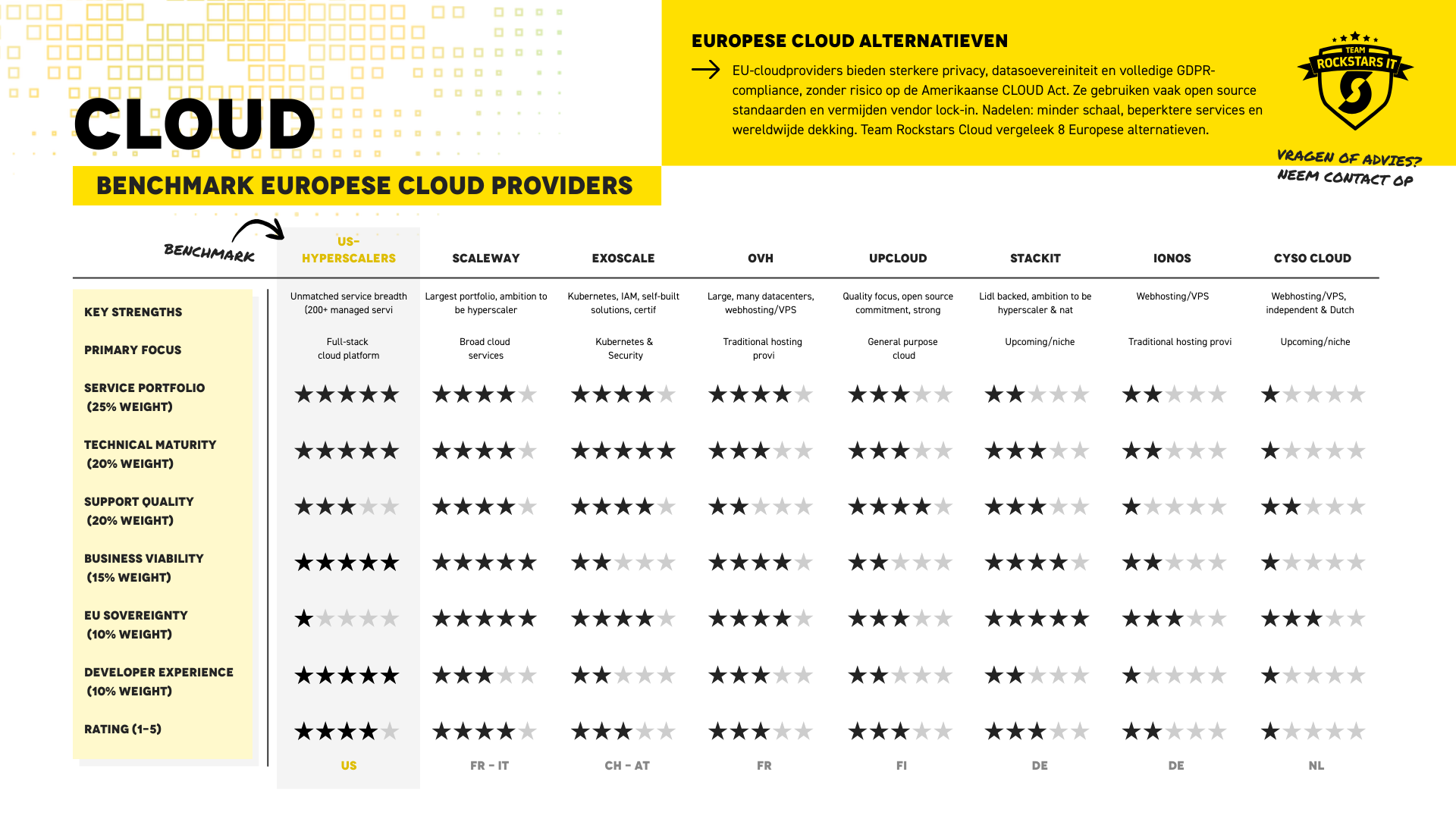
our benchmark of European cloud providers
non-binding conversation
Cloud sovereignty is not about switching, it’s about being prepared. We help you move forward today, with room to make different choices tomorrow.